
How to Become a Renaissance Builder in the AI Era
/ 11 min read
Table of Contents
In December 2025, AWS CTO Werner Vogels took the stage for his final re:Invent keynote.
He didn’t announce new products. He addressed a bigger question: in the age of AI, are developers still relevant?
His answer was an entire keynote building a framework he called the Renaissance Developer.
This article isn’t a keynote recap. I want to borrow Vogels’ framework to explore a question I care about more: In the AI Renaissance, what kind of person thrives?
Every Generation Panics the Same Way
Vogels opened with a short film: from the punch card era onward, every new tool sparked cries of “developers are doomed.”
COBOL arrived—“Anyone can code now, programmers are finished.” Drag-and-drop programming—“No more writing code.” Cloud computing—“Engineers are getting laid off.” AI—“This time it’s for real.”
Four decades, same script, four different props.
But Vogels pointed out a pattern that keeps proving itself: Every time tools lower the barrier to “writing code,” they simultaneously raise the bar for “designing systems, defining problems, and taking ownership.” Compilers didn’t kill programmers—they created software architects. Cloud didn’t kill ops—it created SREs.
AI won’t kill developers. But it will kill developers who can only write code.
Four Conditions for a Renaissance
Vogels compared the present to the Renaissance. Not casually—he provided specific mappings.
Before the Renaissance came the Dark Ages: plague, war, intellectual stagnation. Then curiosity exploded. People began questioning old authorities, re-observing nature. Galileo, Copernicus, da Vinci—they didn’t separate “art” from “science.” They discussed perspective, mechanics, and aesthetics at the same table.
More importantly, tools evolved in the same period:
- The pencil reduced friction in recording and revising
- Vanishing point perspective gave flat paintings three-dimensional depth
- Microscopes and telescopes extended human perception beyond the naked eye
- The printing press enabled knowledge replication at scale
Vogels’ core insight: The Renaissance succeeded not just because of great individuals, but because of the resonance between individuals and tools. Creativity and technology co-evolved.
Mapping to today:
The old order is crumbling. Traditional software development relied on division of labor—PMs write specs, designers create mockups, engineers write code, QA tests, ops deploys. AI is loosening this assembly line.
New tools are exploding. AI models, cloud infrastructure, robotics hardware—like the Renaissance’s printing press and microscope, a massively expanded “toolkit.”
Knowledge acquisition costs are plummeting. Learning a new language used to take months; now you learn as you go. Building an MVP used to take weeks; now it takes days.
Multiple golden ages are converging. Space, AI, robotics, biotech—not a single-track breakthrough, but multi-domain convergence. Progress in any one field gets amplified by the others. This looks more like the Renaissance than the last decade’s mobile internet.
All four conditions are met. But the Renaissance also lasted over two hundred years. For the first few decades, most people were still doing medieval things. We’re probably in that phase right now.
From Developer to Builder
Vogels spoke of the Renaissance Developer—the coder. His five qualities—curiosity, systems thinking, precise communication, ownership, polymathy—are solid.
But I think he undersized it by one level.
What AI is truly changing isn’t just coding. It’s the entire process of “building things.” One person can simultaneously be PM, designer, engineer, ops, and marketer. Not because they master everything, but because AI has lowered the barrier of each domain to a point one person can reach.
So I prefer to call it Renaissance Builder.
But a Builder isn’t “someone who does everything themselves.” It’s “someone who knows what to do and what not to do.”
Three examples make this clear.
Three Types of Judgment
Peter Steinberger retired and used AI to single-handedly build dozens of open-source projects spanning Swift, TypeScript, Python, and Rust. OpenClaw hit 34,000 stars in 48 hours and broke 157,000 in 60 days. In January alone, he made 6,600+ commits.
“From the commits, it might appear like it’s a company. But it’s not. This is one dude sitting at home having fun.”
He barely writes code. “I ship code I don’t read.” What he judges is architecture: dozens of modules, which ones should be split into independent projects, how interfaces should be designed, what abstractions will become tech debt in three months. These judgments come from 13 years of building PSPDFKit—iOS, Android, Web, Server, PDF standards, enterprise sales—he’s been through it all. AI can write code, but it can’t produce this kind of cross-domain intuition.
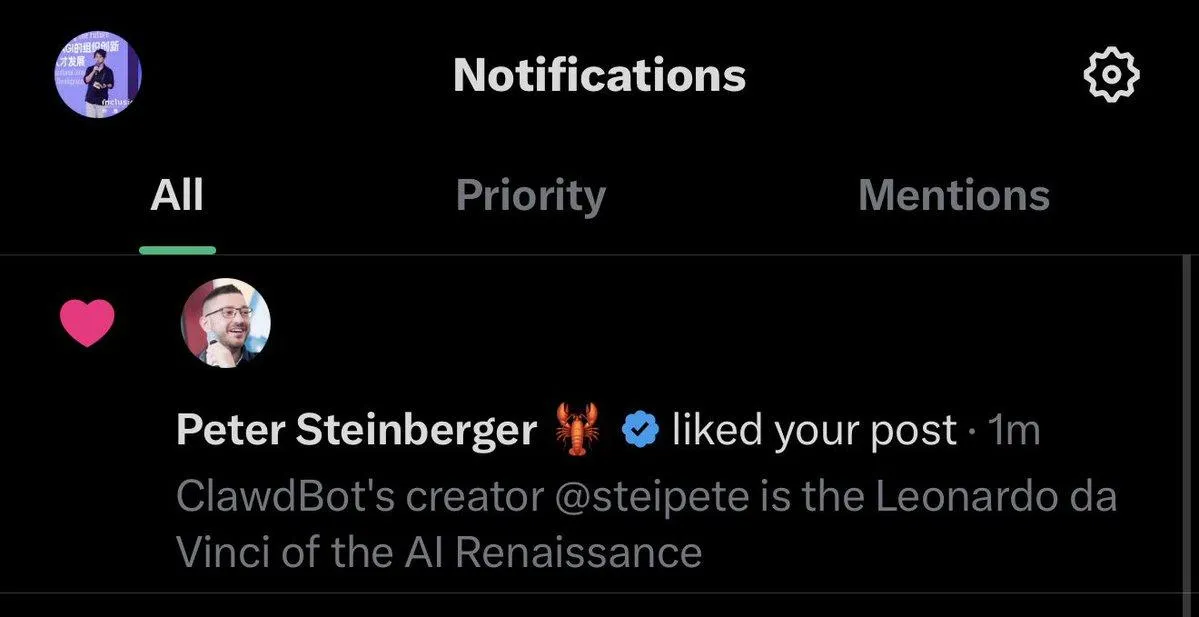
A while back I tweeted that he’s the da Vinci of the AI Renaissance. He liked it himself.
Pieter Levels has a ridiculously simple tech stack—PHP, jQuery. But he earns $138K/month (November 2025), running NomadList, RemoteOK, and PhotoAI entirely solo. What he judges is demand: over a decade of building countless projects, most of which failed. The survivors are the ones where he most accurately read a group’s pain points. AI accelerates the trial-and-error cycle, but “what to try” is something AI can’t help with.
Simon Willison uses AI to build small tools that were previously “not worth building”: Datasette, llm CLI, shot-scraper… His judgment lies in topic selection—picking the genuinely needed ones from an infinite sea of possibilities. Twenty years of engaging with the developer community honed that eye. AI can help you ship a tool in a day, but it doesn’t know which tool is worth building.
Peter judges architecture, Pieter judges demand, Simon judges topic selection. Three completely different types of judgment, none of which AI can execute.
Verification Debt: The New Tech Debt of the AI Era
Vogels introduced a concept in his keynote that I think was the most penetrating of the entire talk: Verification Debt.
AI generates code far faster than humans can understand it. Code can “appear instantly,” but understanding and verification cannot. This means systems approach production before they’ve been truly understood.
This isn’t a coding problem—it’s a building problem.
A Renaissance Builder works across a dozen directions solo. Peter Steinberger “ships code he doesn’t read.” The efficiency is staggering, but verification debt accumulates too—code you don’t read is still your responsibility when it breaks.
Add hallucination—models producing confident but incorrect designs, referencing non-existent APIs, proposing over-engineered solutions—outputs that “look plausible but have no basis in reality.” You won’t catch them unless you look carefully.
Execution got faster, but verification didn’t. That gap is verification debt.
How do you pay it down? Vogels’ answer isn’t “be more careful.”
Mechanisms vs Good Intentions
Vogels told an early Amazon story. A vendor kept messing up table packaging—70% return rate. Everyone said “let’s make sure this never happens again.” But good intentions changed nothing.
Until they built an “Amazon version of the andon cord”—giving customer service a button to immediately mark problem products as unsellable, triggering alerts to the relevant teams. The problem vanished.
“Good intentions don’t work. Mechanisms do.”
This applies equally to Renaissance Builders. You can’t fight AI hallucination with “I’ll pay attention to quality.” You need mechanisms.
Vogels listed several:
- S3 team’s durability review: Any change involving data durability requires a systematic risk modeling pause, listing all threats and guardrails
- Code review—he actually advocates for more human-to-human review in the AI era. The logic is simple: AI can produce code infinitely fast, so review becomes the critical control point—the place to pull human judgment back into the loop
- Andon Cord: Hang an “emergency pull cord” at critical junctures, letting anyone halt the entire line when they spot a problem
For a solo Builder, “mechanisms” might be lighter, but the principle is the same:
Don’t rely on your attention. Design processes that make the correct behavior the path of least resistance.
Run tests after writing code. Go through a checklist before every release. Use specs to constrain AI’s output space rather than relying on vibe coding luck.
Taming Natural Language with Specs
Speaking of constraining AI, Vogels’ keynote included a very practical segment.
The Kiro IDE team’s Clare Liguori discovered a problem: the hidden cost of vibe coding is enormous. You tell AI “build me a web trivia game,” and it picks a single point from a vast solution space—which is almost certainly not the one in your head. Then you spend enormous time getting AI to “fix the code” instead of “clarifying the requirements.”
Her solution is called spec-driven development: instead of letting AI write code directly, first have it output a three-layer structure—
- Requirements: What the system does and doesn’t do
- Designs: Architecture, data flow, component responsibilities
- Tasks: Broken down into executable small steps
Iterate at the spec layer until it matches your mental model, then let AI generate code based on the spec.
Clare put it well: “Natural language doesn’t have to mean high ambiguity.”
This is especially important for Builders. You’re building alone—no PM writing PRDs, no tech lead reviewing architecture. If you haven’t thought through what AI should do before letting it start, verification debt grows exponentially.
Specs aren’t bureaucracy. Specs are the cheapest quality assurance when building solo.
Systems Thinking: Solo Builders Need the Big Picture Even More
Vogels used Yellowstone’s wolves to illustrate systems thinking.
In the early 20th century, wolves were removed from the park. It seemed like a good thing—fewer predators, more elk.
But what actually happened was a trophic cascade: too many elk → vegetation stripped bare → trees disappeared → riverbank erosion → entire ecosystem collapse. When wolves were reintroduced in 2010, vegetation returned, beavers came back, rivers changed course. Not because wolves “directly pushed the river,” but because predators changed the entire system’s feedback loops.
Mapping to the Builder’s world: Every local optimization introduces new feedback loops. Some stabilize the system; some destroy it.
On a team, different roles help you see blind spots. PMs catch requirement drift, designers catch UX degradation, ops catches stability issues. Building solo, you need to create all these feedback loops yourself.
Peter Steinberger can run dozens of projects solo not because he watches everything himself, but because he decomposed the system into modular small projects—bird, sag, gifgrep, mcporter—each solving a specific problem with clean interfaces that compose together. That’s system design, not a pile of scattered side projects.
Simon Willison follows the same pattern. Each small tool is independent, but together they form a tool ecosystem. Systems thinking isn’t necessarily drawing architecture diagrams—sometimes it’s choosing to build small, composable things instead of one big, tightly-coupled thing.
Vogels recommended Donella Meadows’ paper Leverage Points: Places to Intervene in a System. So do I. When you’re building solo, finding leverage points matters a hundred times more than investing effort in every corner.
”The Invisible Work”
Near the end of his keynote, Vogels mentioned an easily overlooked quality: professional pride in “invisible work.”
Users won’t applaud your database optimizations or write thank-you notes for your deployment pipeline. They only see “click and it works.” But a system running stable through the night, failures preempted, deployments and rollbacks happening silently—those are all choices engineers made “when no one was watching.”
He believes this is the shared trait of the best developers: Doing the right thing even when no one is looking.
This hits especially hard for indie Builders. You’re building solo—no code review, no QA team, no SRE. No one notices if you cut corners. But the system knows. Users will eventually know.
The barrier to being a Renaissance Builder isn’t tools. It’s the stubbornness to do things right even when no one is watching.
How to Become a Renaissance Builder
Vogels’ five qualities—curiosity, systems thinking, precise communication, ownership, polymathy—make a great self-assessment checklist.
But if I could give only one piece of advice: Build lots of small things.
Peter Steinberger didn’t spend three years on one perfect product. He built dozens of small projects, each solving a specific problem, composing together into the OpenClaw ecosystem. Simon Willison’s Datasette, llm CLI, shot-scraper follow the same pattern. Pieter Levels built countless projects over a decade—most died, and the survivors sustain him.
Every small project is a training session for judgment. You only learn what people want by building. You only learn which abstractions are right by building. You only develop taste by building.
Taste isn’t a gift. Even da Vinci started as an apprentice in Verrocchio’s workshop. Taste is a byproduct of massive practice.
Werner Vogels wore a T-shirt at his farewell keynote printed with Metallica lyrics:
“Trust I seek and I find in you. An open mind for a different view. And nothing else matters.”
Trust, open-mindedness, different perspectives.
The Renaissance gave us da Vinci, Galileo, Michelangelo. The AI Renaissance is giving us a new way to build—a way for one person to become an entire team.
This way is being defined right now. By people like Peter, who ships harder in retirement than before. By people like Pieter, who builds million-dollar businesses with the simplest tech. By people like Simon, who turns “not worth building” into “worth building.”
The tools are in hand. The remaining question is: are you willing to evolve?