SaaS Is Dead? Long Live OaaS? Let's Calm Down.
/ 5 min read
Table of Contents
When Zendesk announced AI agent pricing at $2/automated resolution, “pay-per-outcome” shifted from startup experiment to enterprise strategy. Before that, Intercom’s Fin was already charging $0.99/resolution.
My first reaction wasn’t “SaaS is doomed.”
It was “finally a big company is willing to bet.”
Bet on what? That their AI is good enough to tie revenue to results. Can’t deliver? Zero revenue. Deliver? Every resolution prints money.
This looks like a more honest business model.
But the more I thought about it, the more something felt off.
The “SaaS Is Dead” Narrative
SaaS is going through its longest winter.
The BVP Cloud Index shows public SaaS companies averaging sub-20% growth. Valuations have been depressed since late 2021—over three years now, the longest I’ve seen. Revenue multiples are back to 2017 levels.
The customer side is worse: renewals become downgrade battles. Happy customers are churning too—not dissatisfied, just budget-cut. Where’s the budget going? AI.
The moats SaaS companies spent a decade building—integration ecosystems, data lock-in, user habits—are getting peeled back layer by layer. When an AI agent can read your entire knowledge base in minutes and answer customer questions, do you still need three months to onboard a traditional support SaaS?
So the market is shouting: SaaS is dead, Outcome as a Service (OaaS) is the future.
Stop selling tools. Sell outcomes.
The Seductive OaaS Narrative
The logic is genuinely appealing:
SaaS: You buy 50 Salesforce seats, $7,500/month. 20 people barely use it. You paid for air.
OaaS: AI resolves a support ticket, charges $0.99. Didn’t resolve? No charge.
From “per-seat” to “per-outcome” sounds like business model evolution. Early movers aren’t just startups anymore: Zendesk charges $2/automated resolution, Intercom Fin at $0.99/resolution (top customers hitting 65%+ resolution rates), Bret Taylor’s Sierra AI charges per successful conversation, Cognition’s Devin claims 8x efficiency at Nubank.
The pricing evolution is clear: perpetual license → SaaS (monthly/per-seat) → Usage-Based → Outcome-Based.
OaaS looks like the endpoint.
But Wait
I spent time pressure-testing these cases. The OaaS story is far messier than it appears.
Who Defines “Resolution”?
Intercom Fin claims 51% resolution rate.
But what counts as “resolved”?
User didn’t follow up = resolved? What if they gave up? What if they went to a human agent? It’s like a hospital counting “patient didn’t come back” as “cured.”
Worse: the entity defining the outcome is the same one charging for it. Referee and player are the same.
Adverse Selection: AI Cherry-Picks Easy Cases
Think about how AI support actually works: simple questions (“how do I reset my password?”) get instantly resolved for $0.99. Complex questions (“why was my order double-charged?”) get escalated to humans.
AI takes all the easy money; human teams get stuck with the hardest cases. The company pays twice. And those simple questions AI “resolved”? A well-written FAQ page could’ve handled them.
You might be paying $0.99/pop for a bot that reads FAQs aloud to users.
$0.99 Looks Cheap—Could Be a CFO Nightmare
Traditional SaaS’s biggest advantage? Predictability. $X/month, budget it, done.
OaaS? This month: 50K resolutions. Next month a product bug causes complaints to spike to 200K. Bill jumps from $50K to $200K.
The worse your product, the higher your bill. What kind of pricing logic is that?
Most “Digital Workers” Are Glorified RPA
This keeps nagging me.
The AI employees and AI agents on the market claim outcome-based pricing. But what they do is simple: fixed workflows, fixed outputs, identical strategies for all users, no contextual adaptation.
Last generation used rule engines; this generation uses LLMs. The tone is smoother; the flexibility hasn’t changed.
This isn’t OaaS. It’s “automation billed per unit.”
Real OaaS should mean: for the same support question, AI adapts its strategy based on customer value, history, and emotional state—then charges for genuinely good outcomes. Nobody does this yet.
The Determinism-Flexibility Paradox
Enterprises buying digital workers want determinism: correct every time, predictable, auditable.
OaaS requires AI flexibility: autonomous decision-making based on context.
More flexibility = more uncertainty = higher error rates. Who’s liable?
Lock AI into rigid rules for determinism, and it’s just RPA—not worth outcome-based premiums. Give it real autonomy, and when it screws up, the customer sues you, not the AI vendor.
This contradiction is currently unsolvable.
The Impossible Triangle
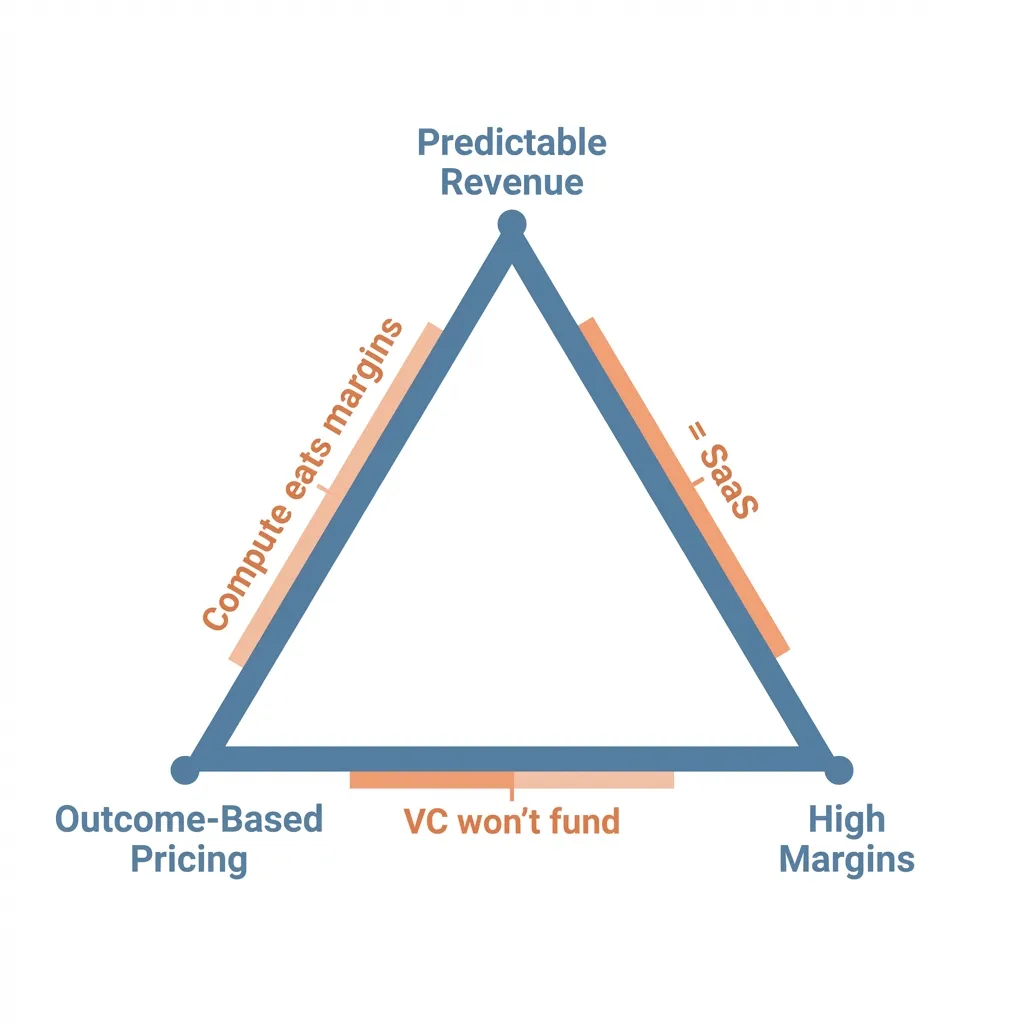
OaaS faces a business model impossible triangle: predictable revenue, outcome-based pricing, high margins—pick two.
Predictable + high margins = SaaS. Outcome-based + high margins = unpredictable revenue, VCs won’t fund it. Outcome-based + predictable = margins eaten by compute costs.
Wall Street loves recurring, hates variable. OaaS companies face harder fundraising and lower valuations.
What’s Actually Happening
SaaS isn’t dead. It’s shapeshifting.
The real trend isn’t SaaS → OaaS. It’s from “selling features” to “selling proof of value.”
Before, you bought SaaS for “this tool can do X.” Going forward, you’ll buy AI products demanding “prove you actually helped me achieve X.”
The pricing mechanism might be monthly, usage-based, outcome-based, or hybrid. The form doesn’t matter. What matters: AI-era products must be accountable for their results. No more shelfware, no more integration lock-in keeping unhappy customers captive. You must continuously prove value.
That’s the genuinely valuable insight behind the OaaS narrative. Not the pricing model itself—accountability.
What OaaS Actually Needs Isn’t Better AI
OaaS’s biggest challenge isn’t technology. It’s missing trust infrastructure.
We don’t lack capable AI. We lack mutually agreed standards for “what counts as a good outcome,” audit mechanisms that prevent sellers from self-judging results, liability frameworks for when AI makes mistakes, and pricing structures that keep costs predictable (caps, tiered pricing, base + revenue share).
Without these, OaaS is just SaaS with a different billing method. Possibly worse, since even the bill is unpredictable.
Final Thoughts
OaaS is a great narrative. But so far, it’s more of a slide in a VC pitch deck than a validated business paradigm.
The winners won’t be companies that “charge per outcome.” They’ll be companies that can prove outcomes—and make customers believe the proof.
As for how they charge?
That’s the least important part.